
Categoria: Processes
Industrial Palletizing System: When to Automate and What Gains to Expect
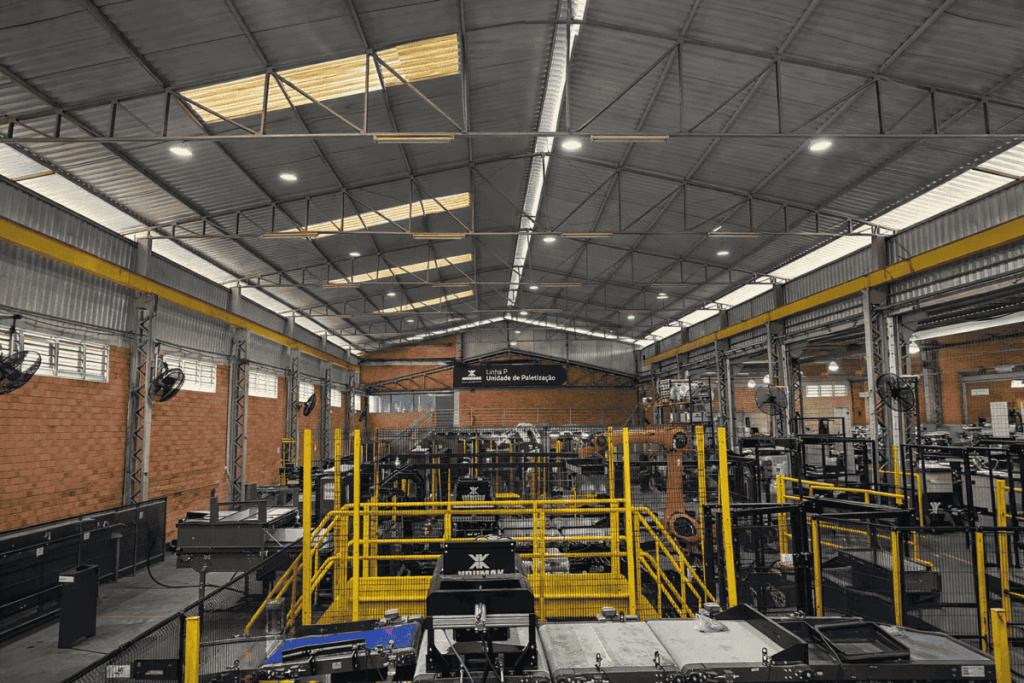
At the end of the line, palletizing is where productivity, safety, and logistics come together. When this stage is manual or poorly standardized, bottlenecks, rework, and, most importantly, unstable loads arise—leading to transport damage and returns.
This is where an industrial palletizing system becomes strategic: it automates pallet formation, standardizes load patterns, and creates a continuous flow to shipping.
What is palletizing and why does it impact operations so much?
Palletizing is the process of arranging bags, bundles or boxes on a pallet following a layered pattern to ensure stability and optimize space usage.
In modern projects, the cell may include conveyors, wrappers, pallet dispensers, slip sheet application, and dedicated grippers, increasing layout and product mix flexibility.
When to automate: signs that usually indicate the right time
Automation doesn’t need to start “big”; it should begin where there is a real pain point.
In general, it is worth considering an industrial palletizing system when at least some of the following scenarios appear:
End of line can’t keep up
If the vertical filler delivers more than the team can palletize, the bottleneck ends up setting the production ceiling.
Damage and load instability have become routine
Drops, misalignments, and inconsistent strapping are costly. Standardization reduces variation and improves stability during handling and transport.
Too much labor allocated just for palletizing
In operations with multiple shifts, recurring costs rise and turnover becomes a concern. Automated palletizing tends to reduce the number of people involved in this repetitive task.
Ergonomic and accident risk
Repetitive movements and heavy lifting increase absenteeism. Automation helps preserve employee health and improve operational safety.
Mix of SKUs and different patterns on the same line
When strapping, height, and orientation change frequently, robotic solutions provide versatility. In Indumak projects, for example, each robotic arm can handle different products and strapping types according to the project.
Partial or full automation: start with the bottleneck
Automating everything at once is not always the best decision. Many companies start with the pallet formation cell and later add peripherals and integrations. The important thing is that the industrial palletizing system allows evolution: changing layer patterns and incorporating stabilization devices.
This way, the industrial palletizing system becomes a modular automation base, adapting to new products and goals without having to “start from scratch.”
What practical gains to expect
Results depend on production rate, layout, and type of packaging, but some benefits are recurring when the system is well designed:
- More productivity and predictability: The automated cell maintains a stable pace and improves process continuity, with controlled handling of the product.
- Load stability and fewer damages: Standardized layers, alignment, and repeatability increase transport safety and reduce rework.
- Better space utilization and organization: More “square” and consistent loads facilitate storage and picking.
- Safety and compliance: Projects follow best practices and safety requirements for robot operation.
- Return on investment: In project case studies, Indumak cites a typical payback of 2 to 4 years, depending on scope and labor involved.
How to choose the right solution: quick checklist
Before finalizing an industrial palletizing system, evaluate:
- Capacity (units/minute) and “headroom” for expansion.
- Product/packaging type (rigidity, friction, deformation) to define the gripper and pattern.
- SKU mix and recipe change frequency.
- Available layout, maintenance access, and integration with the line.
- Necessary peripherals (pallet dispenser, slip sheet, stretch, top sheet, etc.).
Implementation: what ensures results from the first month
To capture gains quickly, the key is to prepare the “before” and the “after”: measure current productivity, map losses, and define a pallet standard (height, strapping, stability). Then, train operations and maintenance teams and maintain a preventive routine, ensuring availability and continuity.
Conclusion
Automating palletizing is not just about stacking faster. It is about transforming the end of the line into a controlled, safe, and repeatable process that delivers stable loads ready for logistics.
If your operation faces bottlenecks, damage, labor costs, and ergonomic risks, an industrial palletizing system can be the next step to boost productivity and optimize end-of-line automation.
Enjoyed the topic? Continue on the Indumak blog to see more content, frequently asked questions, and real applications of palletizing and industrial automation, and find the safest way to accelerate your end of line.
You will also enjoy
- Conect




© 2026 - Indumak Indústria de Máquinas Kreis Ltda - Todos os direitos reservados.
