
Categoria: Movement
6 Advantages of Automatic Palletizing for the Food Industry
Automatic palletizing in the food industry is a strategy capable of solving one of the main bottlenecks in operations: the end of the production line.
When volumes are high, any mismatch between packaging, transportation, and storage can lead to losses and increased operational costs.
On the other hand, modern systems transform isolated stages into a continuous, stable, and predictable flow.
Read the article and discover the six factors that prove why this is an investment that delivers results.
1. Continuous Production at Line Speed
With revenue of USD 280 B in 2025, as highlighted by ABIA, the Brazilian food industry understands that time is money, and any failure can lead to large-scale issues.
Therefore, the less time spent on task execution or product organization, the greater the productivity and financial return.
Automatic palletizing systems deliver exactly that.
They keep up with high production rates, reaching outputs between 750 and 1,200 products per hour, depending on the line layout and load stability.
This feature eliminates misalignment between upstream equipment (such as packaging machines, bundlers, or case packers) and the final dispatch stage.
The result is less product accumulation and greater real efficiency.
2. Load Stability and Reduced Transport Damage
The integration of wrapping modules—such as stationary stretch, orbital, or rotary arm systems—ensures continuous and uniform load wrapping.
This guarantees that the pallet arrives at the warehouse with its quality fully preserved.
After all, stabilized loads:
- Reduce the risk of tipping;
- Minimize product losses due to damage;
- Improve protection against dust and moisture an essential factor for the food industry.
These factors directly impact the perceived quality of the product.
3. Flexibility for Different Products and Packaging
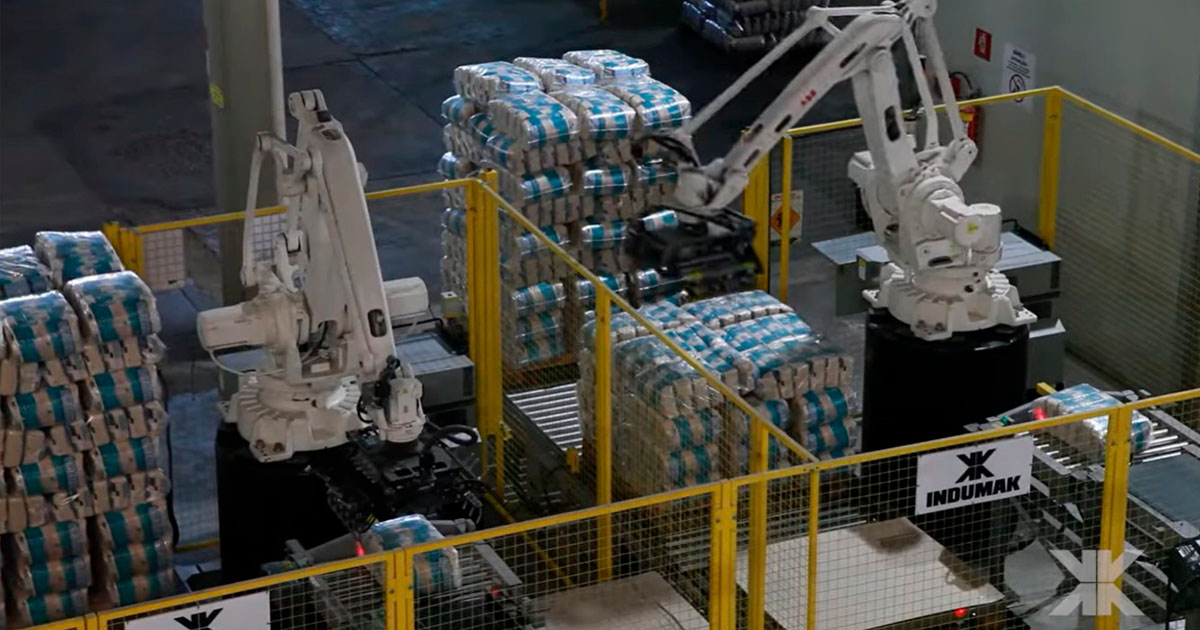
The reality of the food industry is diversity. It typically works with different products and a wide range of packaging types, including cases, bundles, and bags.
High-quality palletizing equipment, such as those manufactured by Indumak, enables this adaptability through:
- Rake grippers, pallet grippers, and dual grippers, according to each need;
- Adjustments based on the type of packaging;
- Configuration according to weight, shape, and stability.
These customized accessories adapt perfectly to both secondary and primary packaging for each product.
These capabilities eliminate operational rigidity and allow the same cell to serve different lines, always maintaining the same level of efficiency.
4. Compact Layouts Adapted to the Plant
Truly efficient palletizing systems for the food industry are designed with compact layouts tailored to the plant, considering:
- Available floor space;
- Internal material flow;
- Pick-up and palletizing points.
With compact and customized layouts, it is possible to maximize space utilization without compromising operations.
This reduces interference, improves internal logistics, and avoids unnecessary expansion.
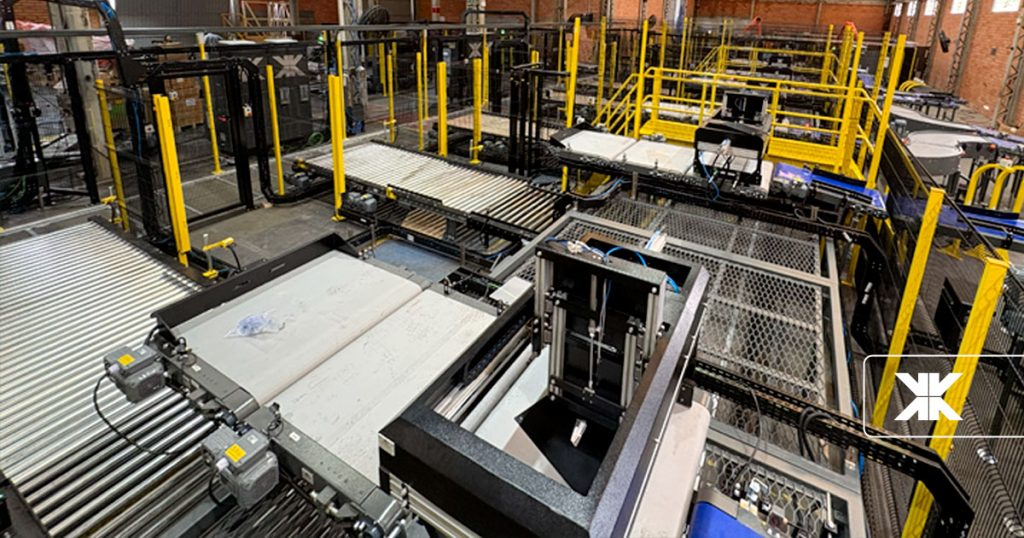
Indumak’s PA-50 palletizing system provides full control over product and process interactions, ensuring precision and continuity.
5. Continuous Operation Integrated with Production
Automatic palletizing does not need to be an isolated stage within the plant.
When integrated with upstream equipment, it creates a continuous flow that connects:
packaging ? bundling ? palletizing ? dispatch
As a result, the process achieves maximum automation with state-of-the-art technology.
In addition, more advanced systems—such as those from Indumak use automated cells that enable:
- Palletizing two products simultaneously;
- Operation with multiple pick-up points;
- Continuous operation without interruptions.
This reduces bottlenecks and increases predictability and production capacity.
6. Reduced Human Intervention and Greater Operational Safety
With automation, critical steps are performed quickly and efficiently:
- Automated (or assisted) pallet exchange;
- Use of pallet magazines;
- Controlled and standardized material handling.
As a result, physical strain on workers is reduced, along with the risk of accidents and process variability. Operational reliability is also increased.
Extra: Financial Return and Consistent Operational Gains with Automatic Palletizing
With embedded technology, acquiring a palletizing system for the food industry is associated with a relatively high initial investment.
However, this investment is typically recovered within a few years, proving to be a highly advantageous solution.
These systems deliver financial gains through:
- Increased productivity;
- Reduced losses due to damage;
- Lower dependence on labor;
- Greater logistics efficiency.
This results in a short- to medium-term payback period, depending on the level of automation and production volume.
Automatic palletizing means greater control, scalability, and efficiency
In the food industry, growing while meeting regulatory and market demands requires both production capacity and process control.
With tailored solutions, full integration, and a focus on performance, palletizing becomes a strategic asset.
Talk to an Indumak specialist and eliminate bottlenecks with a system designed for your operation.
You will also enjoy
- Conect




© 2026 - Indumak Indústria de Máquinas Kreis Ltda - Todos os direitos reservados.
