
Categoria: Packaging
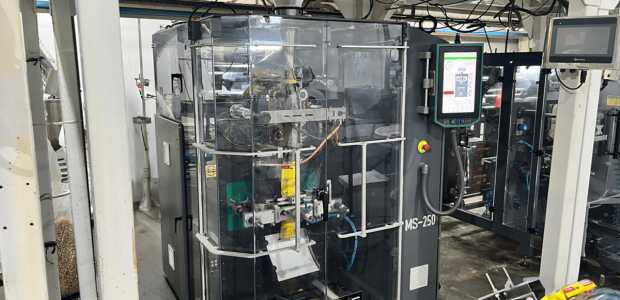
End-to-end automation: how to integrate packaging, case packing, and palletizing
As a production line grows, it’s common for each stage to become an “island”: one machine packages, another groups products, another places them into cases, and in the end someone rushes to build pallets on time. The result quickly becomes clear: bottlenecks, rework, inconsistent standards, handling losses, and logistics constantly putting out fires.
That’s where end-to-end automation makes a difference: it connects packaging to the rest of the end-of-line as part of a single system, rather than as separate pieces of equipment.
At Indumak, we see the line as a continuous flow: from the product leaving the process to the pallet ready for shipping.
Integrating packaging machines, case packers, and palletizing systems (along with conveyors, readers, sensors, and the right control system) is the path to gaining speed, predictability, and efficiency.
Below, we show how this integration works in practice, the benefits it brings, and what to consider to do it the right way.
What does end-to-end automation mean in practice?
End-to-end automation is not just about “having machines.” It’s about ensuring that each stage communicates with the others, shares status, and automatically adjusts according to process variations.
In an integrated line, each module is aware of what happens before and after it, and the control system maintains the pace to avoid buildup, product shortages, micro-stoppages, and handling losses.
In practice, this involves three pillars:
- Continuous physical flow: conveyors, diverters, accumulation tables, aligners, and transfer systems working as a network rather than as improvised sections.
- Integrated logical flow (control): PLCs and HMIs with synchronization logic, product recipes, interlocks, and alarms that make sense for both operators and maintenance teams.
- Data flow: traceability, counting, rejects, performance indicators (such as OEE), and integration with management systems (when applicable).
The goal is simple: to eliminate as much variability as possible from the end of the line and turn the operation into a repeatable process with consistent quality.
Start with the material flow design
Before talking about brand, model, or nominal capacity, the most important step is to map the product’s path and answer: how should it reach the pallet? It may seem basic, but this is where bottlenecks are created.
A well-designed project defines:
- Product format and stability (containers, flexible packages, bottles, primary boxes).
- Grouping pattern (how many per bundle, tray, or case).
- Secondary packaging type (half case, full case, and display).
- Palletizing pattern (layers, interlocking, orientation, maximum height, stretch film, corner boards).
- Logistics rules (internal routes, docks, door height, pallet type, weight limits).
When you clearly define the “destination,” it becomes much easier to size the beginning of the end-of-line. This is the moment when packaging must already be designed with case packing and palletizing in mind: if the grouping comes out irregular, loose, or with dimensional variation, the case is affected; if the case has weight variation, the pallet loses stability; if the pallet loses stability, shipping becomes a risk.
Efficient integration starts with the layout: distances, curves, inspection points, accumulation areas, and maintenance space must be included in the design from the very beginning.
Integration between machines: cadence, buffers, and synchronization
Even excellent machines can perform poorly when the line is not synchronized. The key is to design the overall cadence and use buffers intelligently—not excessively, but enough to absorb small variations.
Some practical principles:
- Balancing by real constraint: identify the true bottleneck (not assumptions) and size the rest to feed it without choking the flow.
- Controlled accumulation: accumulation tables and conveyors prevent stops caused by micro-events, but require control logic so they don’t turn into “traffic jams.”
- Proper sensing: presence, counting, fault detection, and queuing sensors must be placed in the right spots; adding more sensors doesn’t fix a poor layout.
- Product recipes: SKU changeovers cannot become an endless sequence of manual adjustments. The integrated line should operate with recipes and consistent parameters across stages.
- Interlocks and permissives: when one stage slows down or stops, upstream equipment must “understand” and respond (slow down, accumulate, or stop safely).
At Indumak, this synchronization is designed for the reality of the factory floor: easy to operate, easy to troubleshoot, and robust enough to run across multiple shifts.
Smart case packing: from grouping to closing
Case packing is the point where “any variation” turns into cost: poorly formed cases, misaligned products, inconsistent sealing, labels out of standard, weight outside the expected range.
For this reason, it should be treated as a precision stage—not just “putting products into a box.”
In an integrated line, efficient case packing typically combines:
- Reliable case forming and feeding, with a magazine suited to the box type and quick changeover.
- Consistent product insertion, whether by gravity grouping, cartesian, linear systems, or robots.
- Standardized closing (tape or hot-melt adhesive), with repeatable parameters and inspection when needed.
- Quality control at the right point, such as presence verification, counting, code reading, and automatic rejection.
- Identification and traceability, allowing logistics to receive units with correct and repeatable information.
When case packing and palletizing are well connected, the box standard is “born” with the pallet standard in mind. This reduces tipping, eliminates improvisation with stretch film, and increases stability during transport.
Palletizing and end-of-line: stability, traceability, and shipping
Palletizing is the last step before logistics takes over, and it is often where problems created earlier become visible. An automated and integrated palletizing system addresses three things at once: throughput, stability, and standardization.
The elements that most impact end-of-line performance:
- Well-defined layer pattern: proper interlocking, case orientation, overlap, and weight distribution.
- Pallet conditions: broken, wet, or uneven pallets compromise any pattern. Selection and quality control are part of the project.
- Stretch film application and accessories: properly applied film, with adequate tension and a consistent program, reduces damage and returns.
- Outbound traceability: pallet identification, labeling, and (when applicable) integration with WMS/ERP to provide inventory visibility and speed up shipping.
When the end-of-line is connected to the rest of the system, it becomes possible to automatically adjust speed, layer patterns, and production sequence. This avoids a common scenario: palletizing “chasing” what came before.
And yes—even the initial packaging benefits, as it starts operating within a stable cadence, with fewer stops and abrupt restarts.
Measurable benefits: productivity, standardization, and logistics efficiency
Integrating the three stages is not just about “modernizing.” It is about generating tangible results that show up in performance indicators and in the team’s daily routine.
Productivity: higher OEE, fewer micro-stops
When the flow is continuous and the logic is integrated, OEE tends to increase for three reasons: fewer stops due to lack of synchronization, less manual intervention, and less loss from rework. Instead of stopping the line to “fix the end,” the end-of-line keeps pace with production.
Standardization: repeatable output quality
Standardizing is not about rigidness; it’s about reducing variation. An integrated line delivers the same grouping pattern, the same closure quality, and the same pallet, shift after shift. This reduces damage, complaints, and hidden costs.
Logistics efficiency: faster and safer shipping
Stable pallets make better use of space, facilitate internal movement, and reduce the risk of tipping or crushing. Additionally, with proper identification and traceability, logistics gain speed, reduce discrepancies, and improve service levels.
There is also a benefit that few measure at first: predictability. When the end-of-line is reliable, planning stops “padding” the schedule to compensate for unforeseen events. That confidence becomes capacity.
All of this connects to a central point: packaging ceases to be an isolated step and becomes part of a strategy for shipping products ready to store and transport efficiently.
Best practices for pain-free integration (and without rework)
A successful integration almost always follows a set of best practices. Here’s what we most often see making a difference:
- Clearly define SKUs and variations
- List sizes, formats, weights, box types, pallet patterns, and volumes per shift. Integration depends on “known variation,” not surprises.
- Plan product changeovers (setup) as a requirement
Quick changeover is not a luxury. It includes guides, adjustments, recipes in the HMI, changeover devices, box identification, and standardization of consumables. - Design with maintenance and operation in mind
Access to critical points, conveyor passages, space for module removal, safety guards, and ergonomics reduce long stops and improve safety. - Automate strategic inspections
Presence checks, counting, code reading, and automatic rejection prevent errors from “traveling” to the pallet, where they become costly. - Use indicators from start-up
Map losses by category: stops, micro-stops, scrap, rework, lack of supply, feeding failures. Without this, improvement becomes guesswork. - Invest in control logic and diagnostics
Clear alarms, straightforward screens, and well-logged events shorten problem-solving time. An integrated line needs to be easy to understand during the shift. - Safety and compliance are part of the design
Guards, interlocks, signage, and regulatory compliance must be included from the start, not as a “late addition.” - End-to-end testing with real product
Commissioning must validate cadence, patterns, rejects, SKU changeovers, and behavior during stops. This is what ensures stability in daily operation.
How Indumak transforms your line into a single system
End-to-end automation is more than just adding equipment: it’s designing an integrated solution, with cadence, logic, and standards aligned to your process and your shipping operations.
When everything works as a system, packaging ceases to be a point of concern and becomes an efficiency lever for the entire factory.
Want to see more examples and solutions in action?
Follow Indumak on Instagram to watch videos of real lines, applications, project behind-the-scenes, and practical automation tips.
You will also enjoy
- Conect




© 2026 - Indumak Indústria de Máquinas Kreis Ltda - Todos os direitos reservados.
