
Categoria: Innovation, Movement
Intelligent Palletizing for High-Volume Operations with Less Manual Intervention
The end of the production line is often where the productivity gains achieved throughout the entire operation begin to disappear.
The production line performs efficiently, the packaging process is properly calibrated, but once products reach the palletizing stage, the pace slows down. This happens because palletizing still depends on manual labor, a process with limited predictability, and a structure that was not designed to scale with increasing demand.
This bottleneck does not appear overnight. It develops gradually as production volumes increase and manual operations can no longer keep up.
For industries with high product turnover, such as food processing, agribusiness, and packaged consumer goods, the direct consequences are reduced productivity, higher rework costs, and constant pressure on the workforce.
What Truly Defines Intelligent Palletizing
The term “intelligent palletizing” is widely used, but in practice, it has a very specific meaning: it refers to a system capable of receiving products, arranging them on pallets according to predefined patterns, and operating continuously without requiring human intervention at every cycle.
Achieving this requires three components working together seamlessly:
- Programmable control: The system knows which stacking pattern to use for each product, switches configurations without prolonged downtime, and monitors the operation in real time.
- High-precision robotic arms: They perform the physical handling with complete repeatability, ensuring consistent cycle times and placement accuracy.
- Layout-specific peripherals: These include infeed conveyors, pallet dispensers, stretch-wrapping systems, and end-of-arm tooling designed for each product or packaging type.
When these three elements are fully integrated, the operation stops being reactive and becomes a controlled, predictable process.
Why High-Volume Operations Require Intelligent Palletizing
Production lines handling between 900 and 1,200 units per hour leave no room for instability at the end of the line.
Even working at a steady pace, an operator cannot keep up with this volume without interruptions. Every pause causes products to accumulate, creates bottlenecks, and disrupts the flow of the upstream process.
In addition, high-volume operations magnify the impact of any mistake. A poorly built pallet on a line producing 1,000 units per hour represents a far greater loss than on a line producing only 200 units per hour.
Human variability, which may be acceptable in low-volume operations, becomes a significant operational risk in high-throughput environments.
There is also another factor that many managers underestimate: labor costs increase in direct proportion to production volume.
Without automation, increasing production means hiring more end-of-line operators. With intelligent palletizing, that relationship changes. The system absorbs higher production demand without requiring the workforce to grow at the same pace.
How Intelligent Palletizing Reduces Manual Intervention Without Losing Control
Reducing manual intervention does not mean giving up control. In practice, the opposite is true.
A properly configured intelligent palletizing system provides managers with greater visibility into the operation than any manual process. The control panel records production cycles, detects anomalies, allows parameter adjustments, and monitors operational status in real time.
Instead of being an essential part of every production cycle, operators take on a supervisory role, intervening only when necessary.
This transforms the dynamics of the factory floor. Teams that were once assigned to repetitive end-of-line tasks can focus on line monitoring, production setup, and preventive maintenance, activities that add greater value while reducing physical strain.
From an erg
onomic standpoint, the benefits are immediate. Manual palletizing requires repetitive movements while handling loads that can amount to several tons over the course of a shift.
Repetitive strain injuries are among the leading causes of work-related absences in high-intensity industrial operations. Automation systematically eliminates this risk.
Read also: 6 Benefits of Automatic Palletizing for the Food Industry
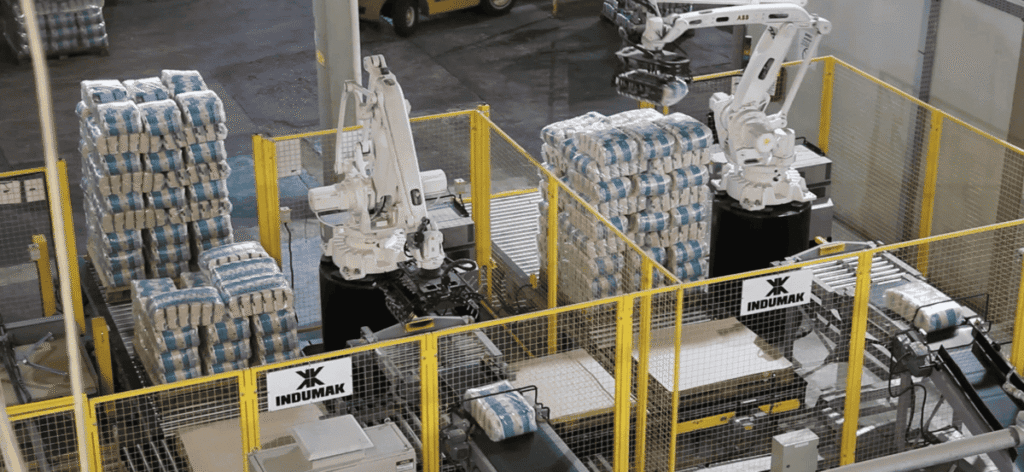
PA-50: Indumak’s Intelligent Palletizing System with a Layout Tailored to Each Operation
Indumak developed the PA-50 specifically to meet the demands of high-volume operations with a wide variety of products.
Rather than being an off-the-shelf solution, the PA-50 is a modular palletizing system whose layout is custom-designed to meet each customer’s operational requirements.
In practice, this means that the palletizing cell designed for a production line handling 25 kg bags of wheat flour will not have the same configuration as one handling frozen food cartons or beverage bundles. The PA-50 accommodates this diversity because it was engineered with flexibility in mind.
PA-50 Technical Specifications:
| Parameter | Specification |
| Production capacity | 900 to 1,200 products/hour (subject to stability analysis) |
| Pallet change | Automatic, via roller conveyors |
| Empty pallet feeding | Via robotic arm |
| Empty pallet capacity | 10 pallets for automatic changeover |
| Compatible robotic arms | ABB, KUKA, or FANUC |
| Operation control | Flexible, with a complete control panel |
| Application | Boxes, bundles, and bags |
The PA-50 control panel manages and monitors every action performed by the palletizing cell, displays operational indicators, and allows programmed task changes without interrupting the production line.
The system operates in compliance with international safety standards, featuring dedicated hardware and a flexible control platform compatible with industrial robots from the leading manufacturers on the market.
Optional Features That Enhance System Performance
One of the key differentiators of Indumak’s approach is the ability to configure the PA-50 with optional peripherals that enhance every stage of the process.
The system goes beyond pallet formation, it can be expanded to include load wrapping, cargo protection, and complete end-of-line automation.
Available optional features for the PA-50 include:
- Stretch Tower and Orbital Stretch Wrappers: Automatic pallet wrapping with stretch film for enhanced load security during transportation and storage.
- Stationary Stretch Wrapper: A compact solution for stretch film application in facilities with limited floor space.
- Specialized End-of-Arm Tools (Articulated, Dual, Clamp, Rake, and Pallet Gripper): Allow the robot to handle different packaging types with precision, eliminating the need for manual tool changes.
- Pallet Magazine (Pallet Dispenser): Provides a continuous supply of empty pallets without requiring operator intervention for each production cycle.
- Slip Sheet: An alternative to conventional pallets for specific load and storage applications.
- Shuttle Car: Automatically transports and positions pallets between process stages, ensuring continuous material flow, greater operational accuracy, and reduced manual interruptions on the production line.
The choice of optional features depends on the product type, expected production volume, and the available plant layout.
Together, these options transform the PA-50 into a complete end-of-line solution, not just a palletizer, but a fully integrated intelligent palletizing cell.
Explore all available options for the PA-50: Indumak Palletizing Options.
What ROI Can You Expect from an Intelligent Palletizing Project?
The most common question among production managers evaluating end-of-line automation is straightforward: how long does it take for the investment to pay for itself?
The answer depends on the specific characteristics of each operation, including current production volume, labor costs, rework rates, and the frequency of downtime. However, several benefits are consistently observed across intelligent palletizing automation projects:
- A 30% to 40% reduction in end-of-line operating costs through the partial or complete replacement of manual labor.
- Elimination of unplanned downtime caused by human variability or ergonomic-related incidents.
- Increased operational availability, allowing continuous production even during periods of high demand or labor shortages.
- Standardized pallet loads, resulting in reduced transportation damage and fewer customer complaints.
For high-volume operations, the return on investment is typically achieved even faster, as the high number of daily production cycles amplifies every efficiency gain.
Implementing Intelligent Palletizing: How Indumak Manages the Process
Transitioning from a manual end-of-line operation to an intelligent palletizing cell does not have to disrupt production. Indumak’s implementation process begins long before the equipment is delivered.
The technical team first analyzes the plant’s existing layout, the types of products running through the line, production volumes per shift, and the specific characteristics of the packaging.
Based on this assessment, the PA-50 project is designed with the appropriate peripherals and a layout configuration tailored to the customer’s specific operation.
After installation, Indumak provides training for the operational team, because a well-operated automated system consistently delivers better performance than one that is simply well installed without a properly trained workforce.
Technical support remains available after commissioning, ensuring that parameter adjustments, component replacements, and software updates can be carried out quickly without compromising production line availability.
When Manual Palletizing Is No Longer Enough for Your Operation
Some warning signs appear before the problem becomes critical. If your operation experiences any of the following situations, it’s time to evaluate end-of-line automation:
- Recurring end-of-line bottlenecks: the production line keeps running, but pallets cannot be completed at the required pace.
- High rates of product damage during shipping: caused by inconsistent pallet stacking.
- Difficulty scaling production without hiring additional operators at the same rate.
- Ergonomic injury-related absences in the palletizing area.
- Production downtime due to operator shortages: a single understaffed shift can affect the entire day’s output.
If two or more of these issues occur regularly, intelligent palletizing is no longer just an operational improvement, it becomes a strategic necessity.
When the end of the production line operates predictably, the entire manufacturing process becomes more stable, from production scheduling to final delivery.
The PA-50 was developed to provide exactly this level of operational balance: advanced technology tailored to the specific requirements of each production process, backed by a company with more than 60 years of expertise in end-of-line automation.
Would you like to learn how this solution can be applied to your operation? Contact us, our team will be pleased to assist you.
You will also enjoy
- Conect




© 2026 - Indumak Indústria de Máquinas Kreis Ltda - Todos os direitos reservados.
